Split in July and August: How to Enjoy the City in the Heat
Split in summer is exactly what the photographs promise: blue sea, white stone, long evenings, and the whole city outside until midnight. It is also hot, properly hot, in a way that catches out people who have only glanced at the average on a weather app. The good news is that the heat here has a rhythm, and once you plan around it rather than against it, July and August are wonderful. This is how the people who live here do it: what June, July and August are really like, the hours to keep off the stone, where to find shade and cold water, and the few kinds of trip for which we would honestly tell you to come in September instead.
By Lovre Ostojić
The Short Answer
Yes, Split is hot in July and August. The average afternoon high is around 31°C in the shade, nights rarely drop much below 23°C, and most summers bring some heatwave days well above that. It is also dry, with around eleven hours of sunshine a day, and the sea is around 25°C, which is about as good as swimming gets in Europe.
It is completely manageable if you follow the rule locals live by without thinking about it. The city in the morning, the sea through the middle of the day, and the city again in the evening. The people who struggle in Split in August are nearly always the ones walking round the old town at two in the afternoon.
If the heat is a real worry rather than a mild one, come in June or in the second half of September. We explain why below, and our best time to visit Split guide covers the whole calendar.
- July and August afternoons average around 31°C, with hotter heatwave days
- The sea is around 25°C, warm enough for long swims
- Walk in the morning and evening, swim through the middle of the day
- If heat is a serious worry, June or late September are kinder
June, July and August Are Not the Same Month
June is the gentle one. Afternoons average around 28°C, the evenings are pleasant rather than warm, and the days are the longest of the year. The sea is still catching up at around 22°C, refreshing rather than warm, and the city is busy without being full. For anybody who dislikes heat but wants summer, June is the answer.
July is the hottest month in the air and the sunniest of the year. The average high is around 31°C, the stone starts holding heat into the night, and the season is in full swing, with the Ultra Europe festival bringing a very large crowd to the city in July and the Split Summer Festival filling the old town with theatre and music.
August is just as hot, the sea is at its warmest, around 25°C, and it is the busiest month of the year. Much of Europe is on holiday at the same time, a lot of Croatia included, and the 15th of August, the Feast of the Assumption, is a public holiday here. The beaches are at their fullest and the ferries at their busiest.
The highest temperature ever recorded in Split, 38.5°C, came in August. Most summers do not come near that, but a few days in the middle thirties are normal, and you should plan as if you will get some.
- June: around 28°C, sea around 22°C, longest days, fewer people
- July: hottest and sunniest, around 31°C, festival season
- August: just as hot, warmest sea at around 25°C, busiest of all
- Expect a few days in the middle thirties in most summers
Why 31°C Feels Hotter in the Old Town
The forecast temperature is measured in the shade, in open air. The old town is neither. Diocletian's Palace is built of pale limestone, polished by centuries of feet, and on a July afternoon the stone throws the sun back up at you from below as well as down from above. Inside the walls the lanes are narrow and the sea breeze does not get in. The Peristyle at two in the afternoon can feel several degrees hotter than the Riva a hundred metres away.
The stone also keeps the heat. By late evening the air has cooled but the walls are still warm, which is why the lanes at ten at night can feel close while the waterfront feels lovely.
Two winds change how a day feels. The maestral is the summer breeze, blowing in from the sea in the afternoon, and it is a big part of why the coast is bearable when inland Dalmatia is baking. The jugo, from the southeast, brings humidity and heavy air, and a jugo day in August is the day everybody slows down.
The practical lesson is simple. Judge the day by where you will be, not by the number on your phone. On the water, 31°C is a beach day. In the Peristyle, it is a reason to come back at six.
- The pale stone of the old town reflects heat and holds it into the night
- The narrow lanes block the sea breeze
- The afternoon maestral cools the coast, the jugo makes it heavy
- The Riva and the beaches feel far cooler than the palace at the same hour
A Summer Day Built Around the Heat
Here is the day that works, the one we would give a friend arriving in August.
From seven to eleven, the city. Walk the palace while the stone is still cool and the tour groups have not arrived, climb the bell tower before the queue forms, and wander the green market while it is at its liveliest. It is the best light of the day for photographs, too.
From eleven to five, the sea and the shade. Swim, eat a long lunch somewhere with a roof, and do what most of Split does in the hottest hours, which is disappear. Going back to your room for an hour in the middle of the afternoon is not wasted time here. It is how you stay out until midnight.
From six onwards, the city again. The viewpoints and Marjan at golden hour, sunset over the islands, and dinner late, because nobody in Split eats early in August. The Riva is at its best after nine, when the stone has given up the last of the day and the whole city walks up and down it.
- Seven to eleven: the palace, the bell tower and the market
- Eleven to five: swimming, shade, a long lunch and a rest
- Six onwards: viewpoints, sunset and a late dinner
- The Riva is at its best after nine at night
The Old Town Before Eleven
Diocletian's Palace is a set of open streets rather than a museum, so you can walk in at seven in the morning with nobody there but the people who live in it. That is the hour to see the Peristyle, the cathedral and the lanes towards the Golden Gate, before the heat and the day's visitors both build up.
The vaulted halls underneath the palace stay cool all day, and so do the cathedral and the churches, which makes them the right places for any sightseeing you could not fit into the morning. The central passage through those halls runs from the waterfront up into the palace, and simply walking through it on a hot day is a relief.
The green market at Pazar, just outside the eastern wall, is at its best early, when the stalls are full of figs, peaches and tomatoes and the traders are still in a good mood. By lunchtime much of it is packing up.
On days when cruise ships are in port, the palace fills with groups from mid morning, which is one more reason to be early. Our complete guide to Diocletian's Palace will help you make the most of those cool hours.
- The palace streets are open all day and nearly empty at seven
- The halls under the palace, the cathedral and the churches stay cool
- Pazar market is best early and winds down by lunchtime
- On cruise ship days the palace fills from mid morning
Where to Hide at Midday
When the middle of the day arrives, the aim is to be in the water, in the shade or indoors. Split has plenty of all three.
The Marjan peninsula is covered in pine woods, and the shade under them is real shade, noticeably cooler and smelling of resin. The small coves on its southern side have trees almost down to the rocks, and a towel under a pine at Kašjuni is one of the best places in the city to spend a July afternoon.
Galleries are cool, quiet and rarely crowded at lunchtime. The Meštrović Gallery, in the sculptor's own villa facing the sea on the edge of Marjan, has a garden as well as its halls, and it is one of the calmest places in Split at the hottest hour. Check its opening hours before you walk out there, because it is a proper walk from the old town.
And then lunch. Choose a konoba with a proper roof or a vine covered terrace rather than a table in full sun, order something cold, and take your time. Our local guide to where to eat in Split has the places we would go.
- The pine woods on Marjan give real, cool shade
- Kašjuni has pines almost down to the water
- The Meštrović Gallery is cool and calm at lunchtime
- Eat lunch under a roof or a vine, not under a parasol in full sun
The Sea Is the Air Conditioning
At around 25°C, the sea in July and August is the single best thing about summer in Split, and the best way to deal with the heat is simply to spend a lot of time in it.
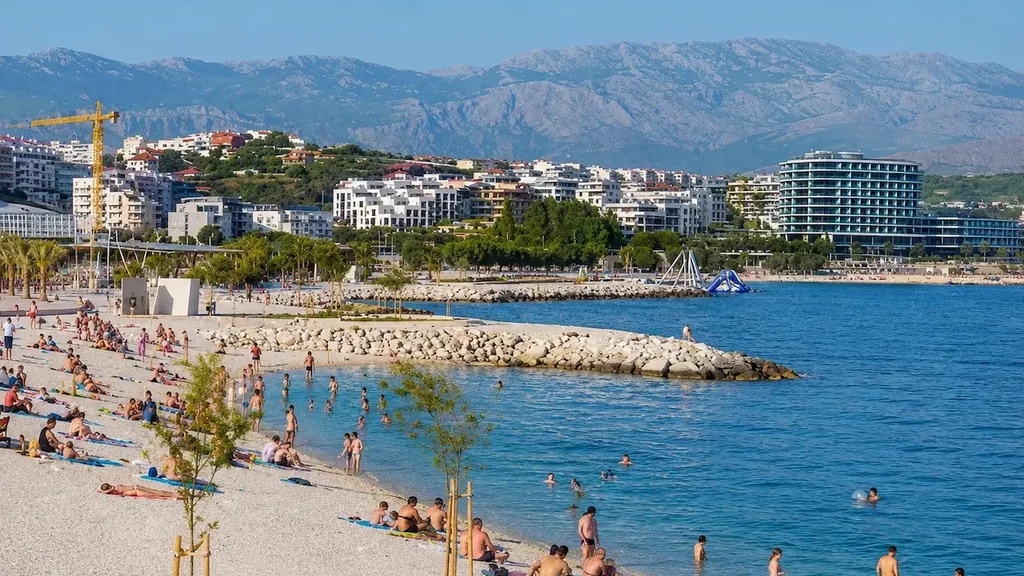
Bačvice, a short walk east of the old town, is the city beach: shallow, sandy by Split standards, lively and full. It is where locals play picigin, keeping a small ball in the air in knee deep water, and it is good for children. By eleven on an August morning it is packed, so go early or go late.
For more space and more shade, head west to the beaches around Marjan. Kašjuni and the coves beyond it are pebble and rock, clearer and calmer, with pine trees behind them. Bring water shoes, because both the rocks and the sea urchins are real. Our guide to the best beaches in Split goes through them one by one.
One summer rule that surprises people. Sunscreen comes off in the sea faster than you think, and the light reflecting off the water burns faster than the sun on land. Put it on again every time you come out.
- The sea is around 25°C in high summer
- Bačvice is shallow, sandy and busy, so go early or late
- Kašjuni and the Marjan coves are calmer, with shade behind them
- Wear water shoes on the rocky beaches
- Reapply sunscreen every time you get out of the water
Marjan, Viewpoints and Sunset After Six
Marjan is the best walk in Split and, between eleven and five in July, one of the worst ideas. The steps up from the old town are steep and in full sun for much of the way. Go early in the morning, or from about six in the evening, when the light turns gold and the climb becomes a pleasure. Our Marjan Hill guide covers the routes.
The Vidilica terrace, at the top of the first climb, looks over the old town, the harbour and the islands, and it is where half the city seems to go for sunset. In late June the sun sets around half past eight, and by the end of August it is closer to half past seven, so plan your evening back from that. There are more places to watch it from in our best viewpoints in Split.
After dark, Split in summer is at its best. The Riva fills with families, the palace lanes fill with music, and the heat finally lets go. Our guide to Split at night is where to go next.
- Walk up Marjan early or after six, never at midday
- Vidilica is the classic sunset terrace over the harbour
- Sunset is around half past eight in late June and half past seven by late August
- Summer evenings are when Split is at its liveliest
Crowds, Ships and the Busiest Days
Heat and crowds make each other worse, and in Split they peak together. The busiest stretch runs from late July to the middle of August, and the days around the 15th of August are usually the fullest of all.
Cruise ships add a daily wave. On days when big ships are in, the old town is busiest from mid morning until early afternoon, which happens to be the hottest part of the day as well. Walk the palace before the groups arrive, or after they have gone back on board.
Ferries and boat trips are at their fullest in the same weeks. Book catamaran tickets and island excursions in advance rather than on the day, and be at the port about an hour before your boat.
The simplest crowd tactic in Split is to go the opposite way to everybody else. When the palace is full, the far side of Marjan and the Meštrović Gallery are quiet. When the beaches are packed, the old town at lunchtime has room. And at seven in the morning, all of it is yours.
- Late July to mid August is the busiest stretch of the year
- Cruise ship crowds peak in the old town from mid morning
- Book ferries and excursions in advance in these weeks
- Go where the crowd is not, and go early
What to Wear, Drink and Carry
A hat, sunglasses and a high factor sunscreen, every day, even if you think you are only going out for a coffee. The Dalmatian sun in July is stronger than it looks from under a café awning.
Shoes with grip. The polished stone of the old town and the Riva is slippery, especially where it has been washed down in the morning, and flip flops on worn limestone are a common way for a summer holiday to end with a sprained ankle.
Something for churches. If you plan to go into the cathedral or any church, bring something to cover your shoulders and knees. A light scarf in a day bag solves it.
Water, and plenty of it. Tap water in Split is safe and good to drink, so carry a refillable bottle rather than buying plastic ones all day. If you are drinking wine or beer in the sun, drink water alongside it.
- Hat, sunglasses and high factor sunscreen, every day
- Shoes with grip for the polished stone
- A light scarf to cover shoulders in churches
- Split tap water is safe, so carry a refillable bottle
Children, Older Travellers and the Heat
Heat affects the youngest and the oldest people in a group first, and it is the most common reason a family day in Split goes wrong. The same rhythm works for everyone, just with more rest built in: mornings out, a long break in the middle of the day, and the evening for anything involving walking.
For children, shallow water at Bačvice and a shaded afternoon are worth more than any sight. Our guide to Split with kids has a whole section on the hottest days.
For anybody who finds walking hard, heat is an access issue as much as a comfort one. Hills, steps and hot stone that are fine in October can be too much in August. Our honest guide to Split with limited mobility explains which parts of the city are genuinely manageable, and how to reach the rest without climbing.
- Plan a long rest in the middle of every day
- Shallow water and shade beat sightseeing for small children
- Heat makes steps and hills much harder for anyone who walks slowly
- Save any real walking for the morning or the evening
Seeing the City Without the Walking
The difficult part of Split in summer is not the old town, which is compact. It is everything else. The viewpoints, the peninsula, the beaches and the villas along the coast are spread over a steep hill, and walking between them in August is a very different thing from walking between them in May.
Buses reach some of it and taxis reach all of it. This is also where we come in, and since we run tuk tuk tours, weigh this section with that in mind. Our tuk tuks have a roof, so you are in the shade while you ride. When you are moving, you get the breeze off the sea that the palace lanes never have. Every tour includes an ice cold drink. And the stops are short, at viewpoints and beaches, so you are out in the sun only for as long as you want to be.
We run tours all day through the summer, from early in the morning until late in the evening, and guests book every hour of it quite happily. The roof is the reason. Riding through the middle of the day is a completely different experience from walking through it, which is why a tour is one of the few things we would actively recommend doing in the hottest hours rather than around them. If you would rather be out when the air has cooled, the Romantic Night Ride goes after the heat has gone and the Classic Tour is lovely in the early morning, but there is no wrong hour to book.
And the honest limit. A roof is shade, not air conditioning. On a very hot afternoon a tuk tuk is far more comfortable than walking, but it is not cool. If anyone in your group really struggles with heat, an early or late ride is the kinder choice, and September is kinder still.
- The old town is compact, but the rest of Split is a steep hill
- Our tuk tuks have a roof and every tour includes an ice cold drink
- We run all day in summer, and guests book every hour without trouble
- A roof is shade, not air conditioning, so ride early or late if heat is hard for you
Days When It Is Genuinely Too Hot
Most summers bring a few days when the heat moves from hot to hard, with afternoons in the middle or high thirties and nights that barely cool. The Croatian weather service issues heat warnings when that happens, and they are worth taking seriously.
On those days, do less. Swim early, stay in the shade or indoors from late morning until early evening, drink more water than you think you need, and move any long walk, hike or boat trip to a cooler day. Nobody who lives here climbs Marjan at three in the afternoon in a heatwave, and nor should you.
Watch for the signs of heat exhaustion in yourself and others: headache, dizziness, nausea or unusual tiredness. Get into the shade, cool down and drink water. Pharmacies in Split are well stocked and the staff speak English, and for anything serious, the emergency number in Croatia is 112.
- Take official heat warnings seriously
- On heatwave days, swim early and stay out of the sun until evening
- Move hikes and long boat trips to a cooler day
- The emergency number in Croatia is 112
When Summer Is the Wrong Choice
We live here and we love the summer, but for some trips it is honestly the wrong season, and it is better to say so.
If anybody in your group struggles with heat, whether because of age, health, pregnancy or simply temperament, come in June or in the second half of September. The sea is still warm, especially in September, and the city is far easier on the body. Our guide to Split in autumn explains why locals think late September is the best fortnight of the year.
If your trip is mostly about walking and sightseeing rather than swimming, July and August cut your useful hours roughly in half. May, June, September and October give you the whole day back.
And if you hate crowds, the first half of August is the one stretch we would steer you away from. Come in the last week of June instead and you get the long days, the warm evenings and the swimming, with room on the beach.
- Heat sensitive travellers are happier in June or late September
- Walking holidays lose half their day in July and August
- The first half of August is the most crowded time of the year
- Late June gives you summer with more space
What We Would Tell a Friend
Come in summer if you want the sea at its best and the city at its liveliest, and plan every day around the heat. The old town before eleven. Water and shade until five. Viewpoints, sunset and dinner after six. Carry water, wear a hat and shoes with grip, and do not climb anything at midday.
Do that, and July and August in Split are everything you hoped for. The people who go home saying it was too hot are almost always the ones who tried to live a northern European day in a Mediterranean summer.