Where to Eat in Split: A Local Food Guide
This isn't a list of ten restaurants, because those lists are out of date within a season and half of them are on the list because somebody paid for it. What's useful in Split is knowing how the food here works: what a konoba is, which dishes are actually local, how fish is priced, when to eat and where the locals go when they're paying their own money. Get that right and you can walk into almost any street in the city and eat well. Get it wrong and you'll spend fifty euros on frozen calamari with a sea view.
By Ante Elez
The One Rule: Walk Two Streets Back
If you remember nothing else, remember this. The terraces directly on the Riva and on the Peristyle are selling a view, and the view is genuinely lovely, but you're paying for the address rather than the kitchen. Walk two or three streets inland, north of the palace towards the Golden Gate, west into Veli Varoš, or east past the market, and the same meal costs noticeably less and is usually cooked with more care.
The other quick filters work almost every time. A menu with photographs of the food, or a laminated board in six languages, is aimed at people who will only ever eat there once. Someone standing outside trying to bring you in is a bad sign. A short menu, a handwritten daily special and a few tables of people speaking Croatian is a good one.
- Two or three streets back from the water is the whole trick
- Avoid photo menus, laminated boards and anyone touting outside
- Short menus and a handwritten daily special are a good sign
- Locals eating there at eight in the evening is the best sign of all
What a Konoba Is, and Why It Matters
A konoba was originally the stone cellar where a family kept wine, oil and cured meat. As a restaurant it means something specific: small, family-run, traditional Dalmatian cooking, usually with stone walls, wooden benches and a menu that hasn't changed much in thirty years. That's where you want to eat.
You'll also see restoran, which is a fuller restaurant and can be anything from excellent to touristy, and gostionica, an informal tavern. Konoba isn't a legally protected term, so a few places on the tourist strips use the name and none of the substance, but combined with the two-streets-back rule it's a reliable guide.
Peka: The Dish You Have to Order in Advance
Peka is the great Dalmatian showpiece. Meat, usually veal, lamb or octopus, goes into a shallow pan with potatoes, olive oil, wine and herbs, and is covered with a heavy bell-shaped iron lid that's buried in embers for two or three hours. Everything cooks slowly in its own steam. It comes to the table under the lid and it is, for most people, the best thing they eat in Croatia.
The catch is that you can't order it on the night. Restaurants need to know several hours ahead, often a full day, and they usually cook it for a minimum of two people. So call or drop in the day before, decide between the octopus and the veal, and book it for your last evening. It's worth building a plan around, which is why it appears in our 3 day Split itinerary. Peka is also the classic dish for a birthday table, and our guide to celebrating in Split has more on booking for a group.
- Order at least a day ahead, most places need the notice
- Usually a minimum of two people
- Octopus peka is the most Dalmatian version, veal the most popular
- Allow two to three hours at the table, it isn't a quick dinner
Pašticada, Split's Sunday Dish
If peka is the showpiece, pašticada is the local one. A joint of beef is larded with garlic, bacon and cloves, marinated overnight in wine vinegar and prošek, then braised for hours with prunes and root vegetables until it's dark, sweet and falling apart. It's served with njoki, hand-rolled gnocchi, and it's what Split families cook for weddings and Sundays.
It takes two days to make properly, so it's normally on the menu as a daily special rather than to order. If you see pašticada written up on a board somewhere in Veli Varoš, that's your lunch decided.
How Fish Is Actually Sold Here
This trips up more visitors than anything else on a Dalmatian menu. Good fish is sold whole and priced by the kilo, not per portion, so a menu line reading '€60' means sixty euros a kilo and a fish that might weigh 600 grams. The waiter will normally bring a tray of the day's catch to the table for you to choose from; ask what it weighs and roughly what it will cost before you nod. Nobody minds the question, and it's much better than a surprise later.
Fish is graded into categories. First-class fish like dentex, sea bass, gilt-head bream and John Dory are the expensive ones. But the real local secret is oily blue fish, sardines and mackerel, which cost a fraction of the price, are grilled over charcoal with olive oil, garlic and parsley, and are what most Dalmatians would happily eat every week.
- Whole fish is priced per kilo, not per portion
- Always ask the weight and the approximate price before ordering
- Grilled sardines and mackerel are cheap and superb
- Fish is best on the grill with olive oil, garlic, parsley and blitva
Black Risotto, Buzara and the Rest of the Sea
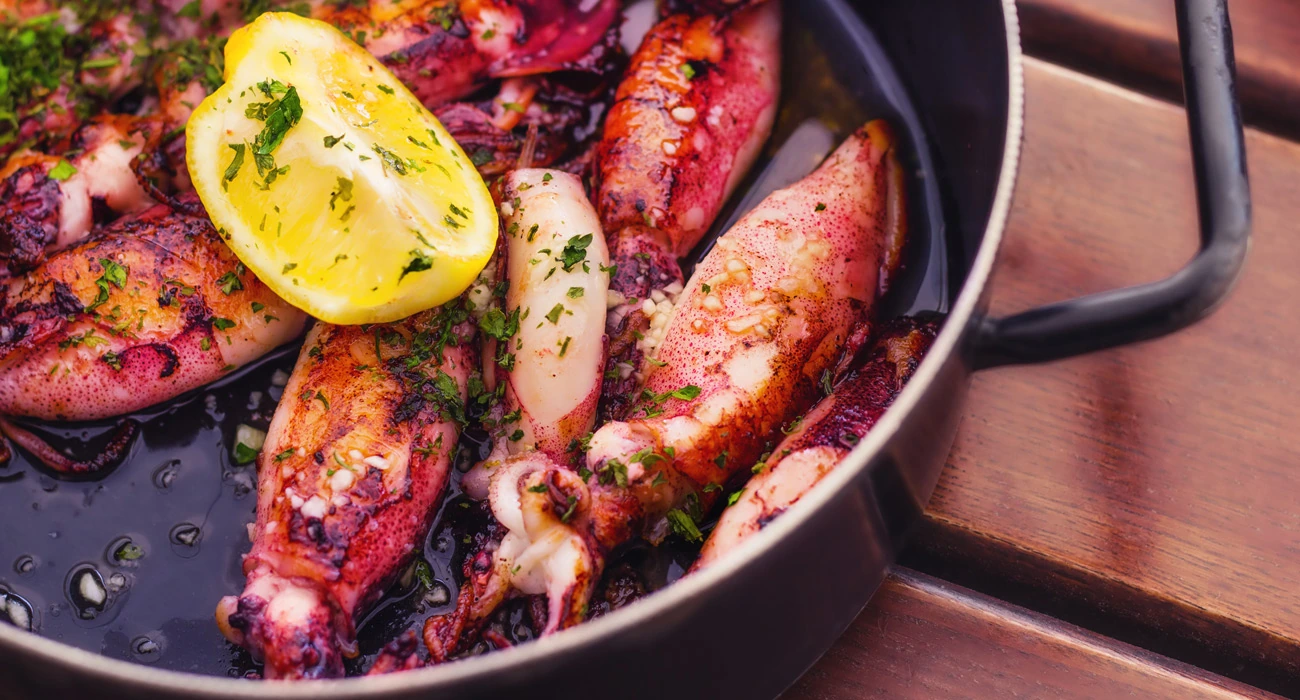
Crni rižot, black risotto, is cuttlefish cooked in its own ink with wine and garlic, and it turns your teeth spectacularly black for about an hour. Order it anyway. Believe me. Buzara is shellfish - mussels, or the langoustines called škampi - cooked fast in white wine, garlic, parsley and breadcrumbs, and it's messy, communal and cheap by seafood standards.
Look out too for gregada, a fish and potato stew from the island of Hvar, and brudet, a richer fish stew served with polenta. Octopus salad, with potato, onion, capers and a lot of olive oil, is the standard starter and it's a good test of a kitchen. Almost everything comes with blitva: swiss chard boiled with potato and drowned in olive oil and garlic.
The Cheap Local Lunch Nobody Tells You About
Marenda is the Dalmatian institution worth knowing. It's a late-morning or lunchtime meal, served in konobas as a short list of daily dishes at a fixed, low price - stews, roast meat, pasta, whatever was in the market that morning - and it's how working Split eats. It's usually chalked on a board, only in Croatian, and served between roughly eleven and two. Ten to fifteen euros for a proper plate of food is normal.
For something faster, the bakeries are excellent and everywhere. Burek, a coiled pastry filled with cheese or meat, is the classic; ask for viška pogača if you see it, a focaccia-like pie from the island of Vis filled with salted anchovies, onion and tomato. Ćevapi with flatbread and onion is the cheap grill option. All of it is a couple of euros, which makes lunch easy on the days you'd rather spend the money on dinner. There's more of this in our guide to free and cheap things to do in Split.
- Marenda is the local set lunch, roughly 11am to 2pm
- Look for a handwritten Croatian board rather than a printed menu
- Bakeries do burek and viška pogača for a couple of euros
- Save the budget for one proper konoba dinner instead
The Green Market and the Fish Market
Pazar, the open-air green market, sits just outside the Silver Gate on the eastern wall of the palace, and it's at its best before ten in the morning: figs, tomatoes, olive oil, cheese, lavender, dried herbs and grandmothers who will let you taste things. It's the most authentically local half hour available in the centre and it costs nothing to walk through.
Peškarija, the fish market, is a short walk west of the palace under an art nouveau roof, and it is famously free of flies, locals credit the sulphur spring next door. Get there in the morning while the trays are full. Between the two markets and a bakery, you can assemble a genuinely good picnic for a beach afternoon, which is what we'd do on a hot day. The best beaches in Split is the other half of that plan.
Which Neighbourhoods to Eat In
Veli Varoš, the old stonemasons' and fishermen's quarter on the slope below Marjan, is the single best area for a traditional dinner: narrow lanes, green shutters, small konobas with six tables and a grill. It's a five minute walk west of the Riva and the prices drop the moment you start climbing.
North of the Golden Gate, around Dobri and the streets behind the market, is where the city eats lunch and where the marenda boards are. Bačvice and the coast east of it are good for a beach-day lunch with your feet in the sand, and Matejuška, the little fishermen's harbour at the western end of the Riva, is where locals sit on the stone at sunset with a bottle from the shop, technically not eating out, but a Split institution all the same.
- Veli Varoš: best area for a traditional konoba dinner
- Behind the market and Dobri: cheap, local, lunchtime
- Bačvice: relaxed lunch with the beach in front of you
- Matejuška: not a restaurant, but the best free seat in the city
Wine, Without the Guesswork
Croatian wine is very good and barely exported, which is why nobody recognises the names. For red, ask for Plavac Mali, the big, warm Dalmatian red grown on the slopes of Hvar, Brač and Pelješac. For white, Pošip from Korčula is the safe, excellent choice; Bogdanuša from Hvar and Vugava from Vis are more local still. Ask what's from the closest island and you'll rarely be steered wrong.
One good fact for the table: Crljenak Kaštelanski, from Kaštela just up the coast from Split, was shown by DNA testing to be the original Zinfandel. Order a bevanda, red wine cut with still water, if you're drinking through a long lunch in the heat, which is what locals do and nobody will blink at. Finish with a rakija: travarica if you want herbs, medica if you want honey.
Coffee Is a Social Event, Not a Drink
Split takes coffee more seriously as an institution than as a beverage. Going 'na kavu' means sitting down for an hour or two, usually outdoors, usually with the same people, and ordering one macchiato in that entire time. Nobody will rush you, nobody expects you to order again, and getting takeaway coffee to walk with marks you out instantly as a visitor.
The best time to join in is the late-morning ritual, when every terrace on Narodni trg and the Riva fills up, and again around six in the evening before the promenade. It costs about two euros and it's one of the better free-ish things you can do in the city.
Pršut, Cheese and the Things to Bring Home
Dalmatian pršut is dry-cured ham, air-dried in the bura wind rather than smoked, and a plate of it with paški sir, the hard, salty sheep's cheese from the island of Pag, whose sheep graze on salt-sprayed herbs, plus olives and capers, is the standard Dalmatian starter. It's also the best thing to take home, along with a bottle of olive oil from the market.
For something more specific, soparnik comes from the Poljica region just south of Split: a paper-thin pie of swiss chard, onion and parsley baked between two sheets of dough on an open hearth, rubbed with garlic and oil. It's EU protected, entirely local to this stretch of coast, and most visitors never hear of it.
Something Sweet
Ice cream is taken seriously here and the good places are obvious from the queue of locals at nine in the evening. Beyond that, look for fritule, small doughnuts with rum and citrus zest, and kroštule, twisted ribbons of fried dough, both traditionally festive but sold year-round in season. Rožata is a Dalmatian caramel custard, closer to crème caramel with a hit of rose liqueur.
Figs turn up in everything in late summer, including smokvenjak, a dense dried fig cake pressed with almonds that keeps for months and travels well.
When to Eat, and Whether to Book
Croatians eat late. Lunch runs from about one, dinner starts around eight and half past nine is completely normal in summer; kitchens in the centre generally serve until eleven. Turning up at six will get you a table anywhere, and a room to yourself.
In July and August the good places in the centre do fill up, so book if you have somewhere particular in mind, and always book for peka. Outside the peak weeks you can usually walk in. Tipping isn't obligatory but rounding up, or around ten percent for a proper meal, is normal and appreciated. Cards work almost everywhere; the markets are still happier with cash. There is more of this kind of practical detail in our things to know before visiting Split.
- Dinner from 8pm, and 9.30pm is normal in summer
- Book ahead in July and August, and always for peka
- Round up or leave about ten percent
- Carry some cash for the markets and small konobas
What's Good, and When
Dalmatian cooking follows the season closely. Spring brings wild asparagus, foraged on the hillsides and folded into omelettes, and young lamb. High summer is tomatoes, figs, watermelon and grilled fish, with everything eaten late and outdoors. Autumn is the best of it: the grape harvest, olive pressing, mussels and the first new olive oil, which is greener and sharper than anything you'll buy at home.
Winter shifts inland and heavier, to pašticada, roast meats, cabbage and salted cod on Christmas Eve. If you're still choosing dates, our guide to the best time to visit Split covers the weather and crowds alongside all of this.
Eat Late, See the City First
One practical note that has nothing to do with food and everything to do with enjoying it. Because dinner here doesn't start until eight, the late afternoon and early evening are dead time that most visitors spend wandering the same lanes waiting to be hungry. That's the best window in the day to get out of the centre, up to the Marjan viewpoints, along the west coast, out to Sustipan, while the light is good and the heat has dropped.
Our 80 minute Classic Tour fits neatly into exactly that gap and drops you back in the Old Town in time for a table, and the Romantic Night Ride runs the other way round: sunset, a bottle of Croatian wine at Vidilica, then dinner afterwards. Either way you arrive at the konoba having actually seen Split. If you'd rather build the route yourself, tell us what you'd like to see.
- Late afternoon is the best time to leave the Old Town
- Back in the centre in time for a table at eight
- The Romantic Night Ride pairs sunset with a late dinner
- Pick-up in the Old Town, minutes from the restaurants
Final Thoughts
Eating well in Split isn't about finding a secret restaurant. It's about walking a little further from the water, ordering the thing that's chalked on the board rather than printed in six languages, asking what the fish weighs, and being willing to eat at nine o'clock. Do that and the city feeds you extremely well for the money.
For the rest of the trip around the table, see our guides to Split at night, Diocletian's Palace and the best things to do in Split.