Marjan Hill, Split: The Complete Guide
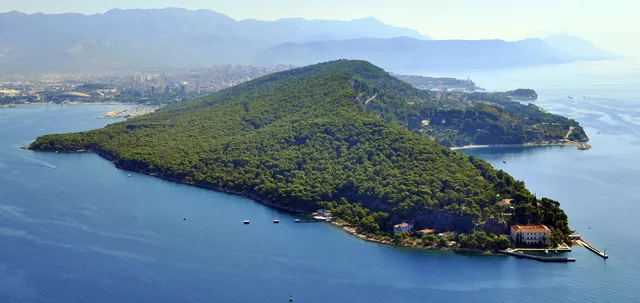
Every visitor who comes to Split is told to go to Marjan and almost nobody is told what that actually involves. Marjan is not just a park in the way most cities have it. It's a whole forested peninsula, roughly three and a half kilometres long, wrapped around the western side of the city, with a summit, a string of cliffside chapels, an art gallery, several beaches and about twenty kilometres of paths on it. You can see the good bits in an hour or spend an entire day and still miss things. This guide covers what's up there, how long each part takes, and how to reach the far half without a long uphill walk in the heat.
By Lovre Ostojić
What Marjan Actually Is
Locals call Marjan the green lungs of Split, and they mean it literally. The whole peninsula has been protected since the 1960s, and the Aleppo pines covering it were planted deliberately, generation after generation, by people who wanted a forest and do good for Split. On a hot afternoon the temperature under those pines is noticeably lower than it is on the Riva and that's one of the reasons why you should definitely go to Marjan.
The important thing to understand before you set off is the shape of it. Marjan rises steeply straight out of the Old Town at its eastern end, which is where the famous stairway and the Vidilica terrace are, then runs west for several kilometres, gradually widening into forest, cliffs, chapels and coves before dropping into the sea at the tip. The eastern end is a 20 minute errand. The rest of it is a proper excursion.
The Climb to Vidilica
The classic way up starts in Veli Varoš, the old stonemasons' and fishermen's quarter just west of the Old Town. Follow the lanes uphill until they turn into a broad stone stairway, and keep going. It takes 20 to 25 minutes at a steady pace from the Riva, and it is genuinely steep in places, but it's a proper staircase with regular landings rather than a scramble.
The climb itself is half the pleasure. You pass the small 13th century church of St Nicholas partway up, the view opens a little more at each landing, and by the time you're two thirds of the way the whole harbour is laid out behind you. Go early in the morning or in the hour before sunset. Doing it at two in the afternoon in August is a decision people regret out loud.
- Start from Veli Varoš, above the Old Town's western edge
- 20 to 25 minutes up, roughly 15 minutes back down
- Almost no shade on the steps, so bring water
- Early morning and golden hour are by far the best times
Vidilica Terrace, the View Everyone Comes For
Vidilica sits at the top of the stairway and is the postcard view of Split: terracotta rooftops, the cathedral bell tower rising out of the palace, the harbour, the ferries and the islands beyond. There's a café terrace right at the viewpoint, so the reward for the climb can be a cold drink with the whole city underneath you.
It is the single most photographed spot in Split, which means it's also the busiest, particularly at sunset in July and August. If you want the view to yourself, come at eight in the morning. Our guide to the best viewpoints in Split covers the alternatives if you'd rather find somewhere quieter.
Telegrin Peak, the Actual Top
Most visitors reach Vidilica, take their photo and turn around, which means the best view on the hill goes largely unseen. Telegrin is the summit at 178 metres, marked by a flagpole and a large stone cross, and the panorama up there is a full 360 degrees: the city and harbour on one side, the open Adriatic and the islands of Brač, Šolta and Čiovo on the other and the mountains of the hinterland behind.
From Vidilica it's another 30 to 40 minutes of walking, mostly on shaded forest paths and a long flight of steps near the end.
The Hermitages and the Cliffside Chapels
The southern cliffs of Marjan hide the strangest and most atmospheric thing on the hill. Hermits lived up here from the medieval period onwards, in cells carved directly into the rock face, and their tiny churches are still there. The 15th century church of St Jerome sits on a ledge above a sheer drop, with the hermit caves just behind it, and the chapel of Our Lady of Bethlehem stands a little further along.
Almost nobody visits them, partly because they're a long way from the stairs and partly because they don't appear on most maps handed out. If you like the idea of standing somewhere silent and 500 years old with the entire Adriatic below you, this is that place. They also feature in our round-up of hidden gems in Split.
The Meštrović Gallery and Kaštelet
On Marjan's southern slope, along the coastal road, is the Meštrović Gallery, the villa the sculptor Ivan Meštrović designed and built for himself in the 1930s. It holds the largest collection of his work anywhere, set in gardens looking straight out to sea, and it's one of the few museums in Croatia where the building competes with the art.
A few hundred metres further along sits Kaštelet, a 16th century walled residence Meštrović bought and restored. Inside its small chapel hangs his cycle of carved wooden panels on the life of Christ, worked on over decades and widely considered his most powerful religious art. One ticket usually covers both, and the walk between them is lovely.
The Beaches Below Marjan
The southern flank of the peninsula is where Split's best swimming is. Kašjuni is the famous one, a wide pebble bay backed by pine with a stylish beach bar, clear deep water and afternoon sun. Ježinac is smaller and more local, Obojena Svjetlost sits just along from it, and there are unnamed rocky coves in between that rarely have more than a handful of people on them.
Right at the western tip is Bene, the most sheltered spot on the hill, with real pine shade, sports courts and calm shallow water, which is why it's a fixture in our guide to Split with kids. The catch with all of them is the same: they're strung along a coastal road with very little shade, and Kašjuni alone is a 45 minute walk from the Riva. Our best beaches in Split guide explains what each one is like when you arrive.
- Kašjuni: pebbles, pine shade, beach bar, afternoon sun
- Bene: calmest water and the best shade, good with children
- Ježinac and Obojena: smaller, quieter, more local
- Water shoes help everywhere, these are pebble and rock beaches
The Quiet Corners Most People Walk Past
Just below Vidilica lies one of the oldest Jewish cemeteries in Europe, founded in 1573 on a terrace of the hillside and still shaded by cypress. It's a remarkably peaceful place and takes five minutes to see, yet the crowds at the viewpoint above it almost never come down.
Elsewhere on the hill you'll find the botanical garden near the eastern slope, an old zoo site that nature has quietly reclaimed, and dozens of unmarked side paths that lead to a bench, a gap in the trees and a view nobody else is looking at.
How to Get to Marjan Hill
On foot, the stairway from Veli Varoš is the only sensible route up to Vidilica, and it's the one everyone means when they say they walked up Marjan. For the far half of the peninsula, walking means committing several hours, because the distances from the centre are considerable and the coastal road is exposed.
By bike or e-bike, the flat seafront path west from Matejuška past the ACI Marina is a pleasure, though the moment you turn inland the gradient becomes serious, and an e-bike earns its money. Taxis, Uber and Bolt will take you to Kašjuni, Bene or the gallery, but you'll then need to arrange the way back, since cars are restricted across much of the park and buses out this way are infrequent. Our full guide to getting around Split breaks down each option.
When to Go, and What to Bring
Timing matters more on Marjan than anywhere else in Split. From June to September, the useful hours are before ten in the morning and after five in the afternoon. Between those, the stone steps radiate heat and the coastal road offers no shelter at all. Spring and autumn are close to perfect up here, with the pines smelling extraordinary after rain, and the best time to visit Split guide has the month by month detail. In spring the whole day is good walking weather, which is why spring is the best season for Marjan.
There are cafés at Vidilica and near Bene, but very little in between, so carry water. And take fire seriously: the whole peninsula is tinder in high summer, open flames are banned, and locals will absolutely say something if they see a cigarette going.
- Go before 10am or after 5pm in summer
- Trainers or grippy sandals, the paths are loose stone
- Carry water, refill points are scarce
- No fires or cigarettes on the trails, the fire risk is real
- Dogs are welcome and Marjan is full of them
Seeing the Whole Hill Without the Climb
Here's the honest problem with Marjan. The famous parts, Vidilica and the stairs, are the easy 20 minutes. Everything that makes the hill special, the summit, the hermit chapels, the western lookouts, the gallery and the coves, is spread across kilometres of forest road, and joining them on foot in summer is a full and fairly punishing day.
That's exactly the gap our tuk tuk tours were built for. An open-sided tuk tuk climbs the hill without anyone breaking a sweat, threads the narrow forest roads a coach could never use, and links the viewpoints, Sustipan, Kašjuni and the western coast into one ride with a local guide pointing out what you're looking at. The 80 minute Classic Tour takes in Vidilica and the coast, and the 120 minute See Everything Tour goes deeper into the peninsula. If there's a particular chapel or lookout you want, just tell us and we'll build the route around it.
- No uphill walking and no midday heat
- Covers the far half of Marjan most visitors never see
- Photo stops at the viewpoints, at your pace
- Pick-up in the Old Town, minutes from the stairs
Final Thoughts
If you do one thing on Marjan, climb the stairs to Vidilica at golden hour and understand why the city sits where it does. If you have longer, keep going west, because the further you get from the stairway the more the hill belongs to you rather than to the crowds.
Marjan is also the reason so many people leave Split saying it was smaller than they expected. It isn't. They just never got past the first viewpoint. For more of what's out there, see the places in Split you can't easily reach on foot and the best things to do in Split.