Split at Night: Where to Go, Eat and Watch the Sunset
Split is a different city after six o'clock. The heat drops, the day trippers get back on their boats and coaches, the stone starts giving back the warmth it collected all day, and everyone who actually lives here comes outside. For a lot of visitors the evening turns out to be the part they remember, and it's also the part they plan least. Here's how a night in Split really works, from where to catch the sunset to when Croatians sit down to dinner, which bars suit which mood, and what's worth doing when you'd rather not be in a bar at all.
By Ante Elez
When the City Changes Gear
Sunset moves a lot through the year here, and it changes what an evening looks like. In late June the sun goes down around half past eight and the Riva stays busy until well past midnight. By mid September it's closer to half past seven, in late October the clocks change and it's dark by six, and at midwinter the light has gone not long after four.
The rhythm is consistent though, whatever the season. Late afternoon is for the viewpoints, dusk is for walking, dinner starts late, and the bars fill up after ten. Plan the evening in that order and you'll never be standing somewhere at the wrong time.
Start With the Sunset, Not the Bar
The best thing in Split at night happens before it's dark. Get up to a viewpoint about 40 minutes before sunset and you get the whole city turning gold underneath you. Vidilica, at the top of the stone stairway above Veli Varoš, is the classic: rooftops, bell tower, harbour, islands. It's also the busiest, so arrive early enough to get a spot at the railing.
Sustipan is the quieter alternative, a flat 25 minute walk west of the Riva to a neoclassical gazebo above the sea with almost no crowd, and the western lookouts on Marjan face straight into the sunset over the islands. Our guide to the best viewpoints in Split compares them all, and the Marjan Hill guide explains how to reach the further ones.
- Vidilica: the postcard view, arrive 40 minutes early in summer
- Sustipan: flat walk, gazebo, far fewer people
- Marjan's western lookouts: straight into the sunset, hardest to reach
- Matejuška: sea level, sunset over the marina, costs nothing
The Riva at Dusk
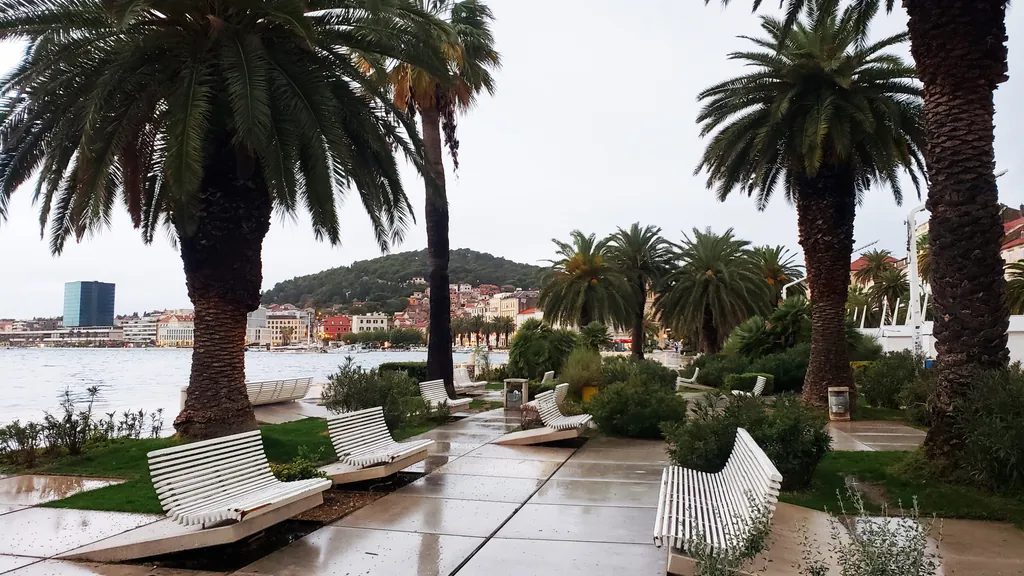
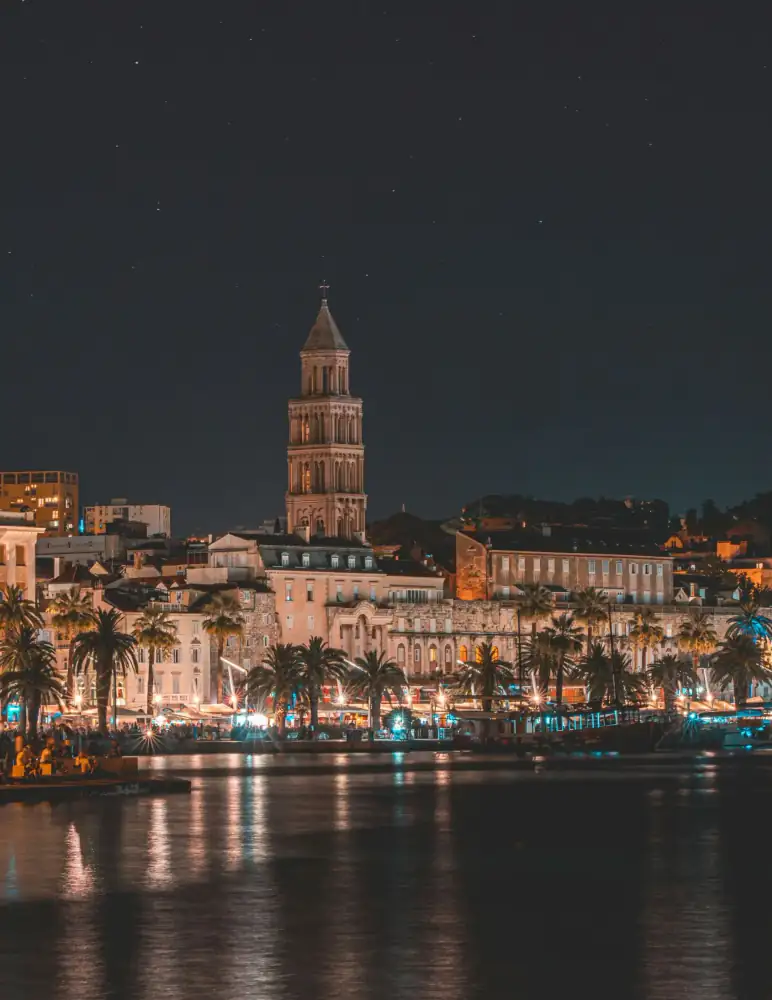
From about seven the whole city walks the Riva. This is the korzo, the evening promenade, and it isn't a tourist thing at all: it's grandparents, teenagers, dogs, prams and people meeting friends they saw yesterday. The palm trees light up, the palace facade glows behind the cafés and nobody appears to be going anywhere in particular.
Order a coffee and take part. Croatians can make one coffee last two hours and consider this a skill worth having. It's free, it's the most authentic hour of the day, and it's the best possible way to start an evening.
The Palace Once the Day Trippers Have Gone
The lanes inside Diocletian's Palace are a completely different place at ten at night. The cruise crowds have left, the shops are shut, the marble underfoot is polished to a shine by 1,700 years of feet, and the lighting turns the Roman stonework into something out of a film set. Walk the Peristyle when it's empty and you'll understand why people fall for this city.
Duck into the Vestibule, the domed room just off the square, and there's a fair chance you'll hear klapa singers, Croatia's traditional a cappella groups, using acoustics the Romans built by accident. It's one of the few things in Split that's better late than early.
Dinner, and When Croatians Actually Eat
Dinner here starts late. Eight is normal, nine is perfectly ordinary in summer, and turning up at six will get you a friendly welcome in an empty room. Kitchens in the centre usually stop serving somewhere around eleven, so the window is later than you're used to but not endless.
Eat a few streets back from the water. A konoba in Veli Varoš or the back lanes of the palace will cook better and charge less than the terraces with the sea view, and that's where you'll find the things worth trying: grilled fish by the kilo, black risotto, pašticada with gnocchi, and peka if you can find somewhere that does it and you order a day ahead. Book in July and August, and see our full guide to where to eat in Split for the rest.
- Dinner at 8pm or later is the local norm
- Two or three streets back from the Riva is better and cheaper
- Fish is priced by the kilo, ask what came in that morning
- Peka usually needs 24 hours' notice, ask when you book
Matejuška, the Most Local Evening in Split
At the western end of the Riva there's a small working fishermen's harbour with a stone breakwater, and on any warm evening it is covered in people sitting on the concrete with a bottle of wine and their shoes off. Matejuška is where Split goes when it doesn't want to spend money, and it has the best sunset in the centre.
Nobody minds you joining in. Bring something from the shop, find a spot on the stone, and watch the boats come back in with the light going pink behind the marina. It's the single most Split thing you can do after dark.
Rooftops and Sea View Terraces
If you want the view with a proper drink in your hand, Split has a handful of terraces that deliver. Roof 68 looks straight down over the palace rooftops and the cathedral tower, the Ambasador rooftop faces the harbour, and the terrace at Vidilica trades cocktails for the best panorama in the city and a 20 minute climb to reach it.
These fill up at golden hour in summer, so either go early or accept that you'll be standing. Prices sit above the street cafés, though not dramatically, and you're paying for the view rather than the drink. Our romantic things to do in Split guide has more if you're planning something for two.
Bačvice, Where the Night Goes On
Bačvice is a shallow, sandy-bottomed bay 15 minutes east of the Riva, and it's a beach by day and Split's main nightlife strip by night. The complex above the sand holds a run of bars and clubs that get going around eleven and keep going until the early hours, mostly outdoors, mostly full of a young local crowd rather than only visitors.
It's a very easy night out: everything is in one place, you walk between venues in thirty seconds, and you can be back in the Old Town in a quarter of an hour. If dancing outdoors near the sea in July is your idea of a good evening, this is where to be.
The Old Town Bar Lanes
For something slower, the alleys inside and just outside the palace walls are full of small bars built into Roman doorways and medieval courtyards, with tables spilling into lanes barely wide enough for two people. This is where you go to actually talk to someone.
The area around the Ghetto and the lanes north of the Peristyle are the heart of it, along with the wine bars near the fruit square. Places open and close between seasons, so the reliable method is to walk a loop, look into a few courtyards and pick the one that sounds right rather than arriving with a list.
Live Music and the Summer Festivals
In summer the city programmes its evenings properly. The Split Summer Festival runs through July and August with opera, theatre and concerts staged in the Peristyle and other open-air spots inside the old city, which is as good as a venue gets. Prokurative, the Venetian-style square just off the Riva, hosts concerts through the season too.
There's also klapa, the Dalmatian a cappella tradition, which you'll stumble across in the Vestibule and in small bars, and the enormous Ultra Europe festival, which takes over the city for a weekend in July and changes the character of Split entirely while it's on. Worth knowing about whether you want to be there for it or well away from it.
A Night Swim
The sea holds its heat long after the air cools, and in July and August the water is genuinely warmer at eleven at night than it feels at eleven in the morning. Bačvice is the obvious spot because it's shallow, lit, and there are always other people around.
Keep it sensible: swim where there's light, don't go far out, and don't combine it with the evening's wine. Done properly it's the thing people talk about for years afterwards.
Evenings Without a Bar in Them
Plenty of the best evenings here involve no drinking at all. The ice cream walk along the Riva is a full activity in its own right and Croatian children are still going strong at ten at night, so nobody will look twice at yours. Đardin, the small park beside the palace, is a calm spot to sit, and the markets and squares stay pleasant long after the shops shut.
For families, the evening is often the best part of the day in summer, since the heat has finally broken and everything is open. Our Split with kids guide has more on how the city works with children in tow.
Is Split Safe at Night?
Yes, and noticeably so. Split is a small city with a large evening street population, the Old Town is pedestrianised and busy until late, and violent crime against visitors is rare. Most people walk back to their apartment at two in the morning without giving it a thought.
The usual sense applies: watch your bag in the crowded lanes at peak season, agree a taxi fare or use an app rather than an unmarked car, and be careful on the polished marble when it rains, which sends more tourists to the clinic than anything else in this city.
Seeing the City Lit Up Without the Walking
The frustrating thing about Split in the evening is that the best of it is spread out. The sunset viewpoints are up a hill, the coastal road faces the right way for golden hour, and the lit palace is back down in the centre, and stringing them together on foot after a full day usually means missing the light while you're still climbing.
That's what our Romantic Night Ride is for. It's a private 60 minute ride timed around sunset, along the west coast and the marina, with a 20 minute stop at the Vidilica viewpoint for golden hour and a bottle of good Croatian wine included, and a local guide driving so nobody has to navigate. It costs 65 euros per person, and couples marking an anniversary or planning a proposal are a big part of who books it, though friends and families take it just as often. Message us with your date and we'll tell you what time the sun goes down and when to set off. If you are marking a birthday or an anniversary, our guide to celebrating in Split covers where to eat afterwards and how to plan it.
- Timed to the sunset, which shifts through the season
- 20 minute stop at Vidilica for golden hour photos
- A bottle of Croatian wine included
- Private ride, pick-up in the Old Town
Final Thoughts
The formula that never fails in Split: a viewpoint before sunset, the Riva at dusk, dinner somewhere back from the water at half past eight, and a walk through the empty palace lanes before bed. Add Bačvice or Matejuška depending on whether you want to dance or to sit on a wall by the sea.
If you're still building the rest of the trip around it, our 3 day Split itinerary slots these evenings into the days, and the best things to do in Split covers the daylight hours.