Diocletian's Palace, Split: The Complete Guide
Diocletian's Palace is definitely the reason most people come to Split, and it's also the thing most people misunderstand before they arrive. It isn't a museum with a gate and a queue. It's a Roman imperial residence that a city grew inside and outside, and 1,700 years later there are still flats, bars and about 3,000 residents living within the Emperor's walls. You can walk into it right now, for nothing, at any hour of the night. This guide covers what's actually inside, which parts cost some money and which don't, how long you need to spend, and the timing that makes the difference between a magical morning and a shuffle through other people's selfie sticks.
By Lovre Ostojić
What Diocletian's Palace Actually Is
The emperor Diocletian was born a few kilometres from here, in Salona, and he did something no Roman emperor had done before: in 305 AD he voluntarily abdicated, and came home to a retirement complex built for him on the coast, here in Split. Half of it was a luxurious seafront villa for the emperor, and the other half a garrisoned military camp, all inside the walls of the palace.
Then Rome fell, Salona was sacked in the seventh century, and its refugees moved into the empty palace because it was the strongest thing standing. They never left. Everything you walk through today, the lanes, the shops, the churches, the apartments, was improvised inside a Roman shell over fifteen centuries. It's on the UNESCO World Heritage list, and it is one of very few Roman buildings anywhere in the world that was never abandoned.
- Built as a retirement palace for the emperor Diocletian, completed around 305 AD
- Roughly 215 × 180 metres, with walls up to 26 metres high
- UNESCO World Heritage since 1979
- Around 3,000 people still live inside the walls
Why It Doesn't Look Like a Palace
Visitors sometimes wander the lanes for twenty minutes looking for the entrance to the palace, not realising they've been inside it since they crossed the first threshold. There's no ticket office for the palace itself, because the palace is the neighbourhood. The Roman structure survives as the street plan, the gates, the walls, the cathedral and the cellars, with medieval and Venetian buildings wedged into every gap between them.
Once you know what to look for, you can't stop seeing it. Roman arches embedded in the wall of a bar. A column doing structural work in a nineteenth century house. The two main Roman streets, the cardo running north to south and the decumanus east to west, still functioning as the main lanes and still crossing at the Peristyle. It's a Roman floor plan with a living city grown over it, which is far more interesting than a ruin behind a rope.
Do You Need a Ticket to Get In?
No. Yeah, you heard me. Walking into the palace and through its lanes is completely free, at any time of day or night, because it's a public part of the city. That includes the Peristyle, the Vestibule, all four gates, the main covered corridor of the cellars and every street inside the walls.
What you pay for is the individual monuments: the Cathedral of Saint Domnius, its crypt and treasury, the bell tower, the Temple of Jupiter, and the eastern and western halls of the cellars. Those are the four or five things worth budgeting for, and there are usually combined tickets that cover several at once for less than buying them separately. Our guide to free things to do in Split covers how much of the city you can see without spending anything at all.
- Entering and walking the palace lanes is free, day and night
- Cathedral, crypt, treasury, bell tower, Jupiter's Temple and the cellar halls are ticketed
- Combined tickets are sold at the cathedral and are better value
- Prices change each season, so check the board at the door
The Peristyle: The Heart of the Palace
The Peristyle is the colonnaded courtyard at the centre of the palace, and it was the ceremonial space where subjects came to greet Diocletian, who liked to present himself as the living son of Jupiter. The red granite columns holding up the arcades were shipped from Aswan in Egypt, along with a dozen sphinxes roughly 3,500 years old, one of which still sits at the southern end, headless neighbours notwithstanding.
Today it's a square with café tables where you buy a drink and sit on a cushion on the steps, and where klapa groups sing most days in season. It's also the busiest 400 square metres in Dalmatia between ten and four. Come back at eight in the morning or after eleven at night and you can have it almost entirely to yourself, which is when it's genuinely extraordinary.
The Cathedral of Saint Domnius
The octagonal building on the eastern side of the Peristyle was Diocletian's mausoleum. In the seventh century it was consecrated as a Christian cathedral and dedicated to Saint Domnius, the bishop of Salona whom Diocletian had martyred, so the emperor's tomb became a church honouring one of his victims, and his sarcophagus was removed. It's often described as the oldest Catholic cathedral still in use in its original structure anywhere in the world.
Inside it's small, dark and dense: the Roman dome still overhead, a thirteenth century carved wooden door, and Romanesque altars packed into a space designed for one dead emperor rather than a congregation. Shoulders and knees should be covered, and it closes during Mass, so allow for a wait if you arrive at the wrong moment.
Climbing the Bell Tower
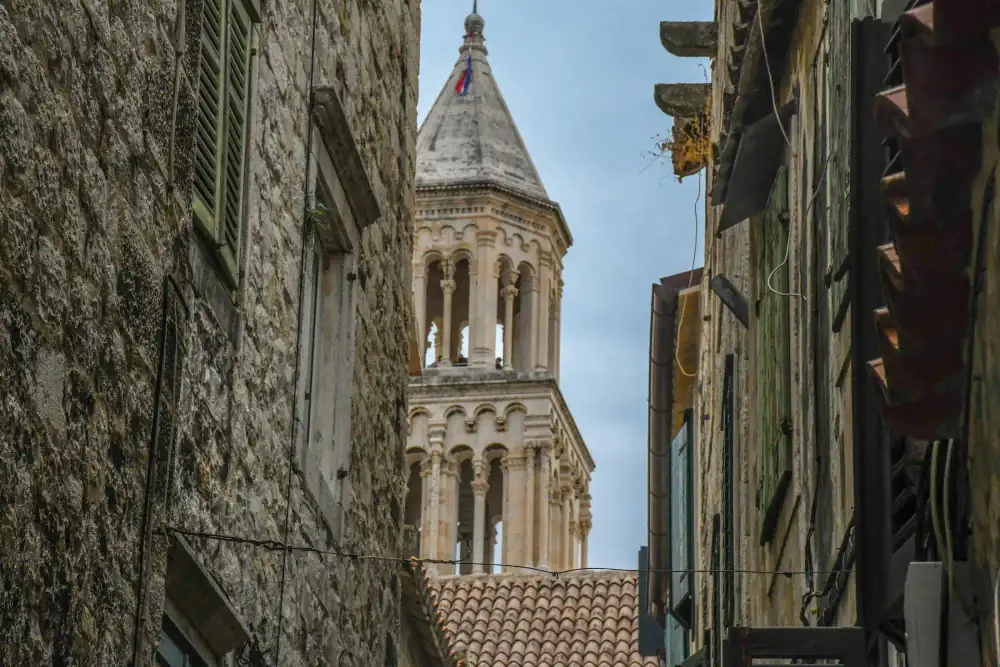
The bell tower next to the cathedral was built and rebuilt between the thirteenth and sixteenth centuries, then almost entirely reconstructed around the turn of the twentieth. It's about 57 metres, and it's the best view in the Old Town by a distance: terracotta rooftops directly below, the Riva and the harbour, Marjan rising to the west and the islands beyond.
It is also a couple of hundred steep stone-and-metal steps up an open staircase, with gaps you can see through and traffic in both directions on the narrow sections. For views without the climb, our guide to the best viewpoints in Split covers the ones you can drive or walk to.
- Around 57 metres and a couple of hundred steep steps
- The staircase is open and narrow, not for vertigo
- Go first thing, it's cooler and far less congested
- Small children need to be held the whole way up
The Substructures, or Cellars
Beneath the emperor's apartments, a vast set of vaulted halls was built to level the sloping ground. Because they held up the rooms above, their layout is an almost exact negative of the imperial apartments, which have long since disappeared. Walk the cellars and you're walking the floor plan of rooms nobody has seen for a thousand years. They were filled with rubbish and rubble for centuries, which is precisely why they survived so well.
The central corridor running from the Bronze Gate up to the Peristyle is free and lined with souvenir and craft stalls. The ticketed eastern and western halls are the ones worth paying for: cool, cavernous, almost empty by comparison, and used as Daenerys Targaryen's throne room and dragon chambers in Game of Thrones.
The Four Gates, and Which to Enter By
The palace has one gate on each side, and which one you use shapes your first impression. The Golden Gate on the north was the emperor's ceremonial entrance, facing Salona, and it's the grandest. Just outside it stands Ivan Meštrović's enormous bronze statue of Grgur Ninski, the tenth century bishop who fought for the Croatian language in church; the big toe is polished gold by the hands of people rubbing it for luck.
The Silver Gate on the east opens straight onto the Pazar green market.
The Iron Gate on the west leads to Narodni trg, the medieval square that became the city's living room, and carries a clock that has been keeping time since the Middle Ages. The Bronze Gate on the south was the sea gate, where supplies came in by boat directly beneath the palace; today it takes you from the Riva into the cellars in about ten steps.
- Golden Gate, north: the ceremonial entrance and Grgur Ninski's statue
- Silver Gate, east: opens onto the Pazar green market
- Iron Gate, west: leads to Narodni trg and the medieval clock
- Bronze Gate, south: from the Riva straight into the cellars
The Vestibule, Jupiter's Temple and the Quiet Corners
Off the southern end of the Peristyle, the Vestibule is a circular domed hall, open to the sky where the dome collapsed, that was the antechamber to the emperor's apartments. The acoustics are remarkable and klapa singers use it daily; standing under the oculus while six men sing unaccompanied is, for a lot of visitors, the thing they remember longest. It costs nothing.
A narrow lane west of the Peristyle leads to the Temple of Jupiter, later converted into the baptistery of Saint John, with a headless black granite sphinx keeping watch outside and a barrel-vaulted stone ceiling inside that's worth the small entry fee. Nearby, look for “Pusti me proć” street, 'let me pass', the narrowest street in Split, which is exactly as wide as its name suggests. There's more of this kind of thing in our guide to hidden gems in Split.
How Long Do You Need?
Two hours covers the essentials at a reasonable pace: the Peristyle, the Vestibule, the cathedral, the cellars and a wander out through two or three of the gates. Add the bell tower and Jupiter's Temple and you're at three, which is what we'd suggest for a first visit and roughly what our 3 day Split itinerary allows.
You could also spend a whole day and not be bored, because the palace rewards aimlessness more than a checklist. But if you're on a tight schedule - a cruise call, or a single day in the city - three hours here and the rest of your time outside the walls is a much better trip than six hours in the same few lanes.
The Best Time of Day to Visit
Before nine in the morning the palace belongs to residents, delivery vans and cats. You can stand alone on the Peristyle, photograph the lanes without a single person in them and hear your own footsteps on the marble. Between about ten and four, especially when cruise ships are in, the main routes are shoulder to shoulder and the temperature inside the stone lanes climbs fast.
The other great window is after ten at night, when the day visitors have gone, the walls are lit and the stone has finally cooled. It's free, it's safe and it's the version of Split that people describe when they get home. Our guide to Split at night covers what else to do with those hours.
- Before 9am: empty lanes, cool stone, the best photographs
- 10am to 4pm: peak crowds, especially on cruise days
- After 10pm: lit, quiet and completely free to wander
- Check cruise schedules if you want to avoid the busiest mornings
What It Costs
Individual monuments inside the palace generally run from a few euros to around ten each, and the combined tickets sold at the cathedral, typically bundling the cathedral, crypt, baptistery and bell tower, work out considerably cheaper than paying separately. Budget somewhere in the region of fifteen to twenty-five euros per person to see everything ticketed, and treat those figures as a guide rather than a promise, because prices are revised most seasons.
Guided walking tours of the palace are widely sold on the Peristyle and along the Riva and are worth it if you want the history properly explained; buy from a licensed guide rather than the loudest tout. Everything else is free: the lanes, the squares, the gates, the Vestibule, the main cellar corridor.
Getting There, and Getting Around Inside
The palace is right on the waterfront. From the ferry port or the bus and train stations it's a five to ten minute walk west along the Riva; from most central accommodation it's less. No cars go inside, so wherever you're coming from, the last stretch is on foot. Waiting for a boat or a bus? Our guide to a few hours in Split shows how much of the palace fits before you have to be back at the pier.
Inside, the marble is polished by seventeen centuries of feet and turns genuinely slippery in rain, so leave the smooth-soled shoes in the room. The lanes are cobbled and stepped, which makes wheelchairs and buggies hard work in places, though the Riva, the Peristyle and the cellar corridor are manageable. For everything on buses, taxis, parking and boats, see how to get around Split.
- Five to ten minutes on foot from the ferry port and bus station
- No vehicle access inside the walls
- The marble is slippery when wet, wear grippy shoes
- Refill bottles at the public fountains around the centre
Where to Eat Around the Palace
The rule inside the walls is the same as everywhere else in Split: the closer the table is to the Peristyle or the Riva, the more you pay for the view and the less you get on the plate. Walk two or three streets back - north towards the Golden Gate, or west into Veli Varoš - and prices drop while the cooking improves.
The Pazar green market outside the Silver Gate and the Peškarija fish market just beyond the western wall are both worth half an hour in the morning even if you're not buying. Our full guide to where to eat in Split covers the dishes to order and how a Dalmatian menu actually works.
The Half of Split That Isn't the Palace
Here's the thing we tell every visitor. The palace is compact, pedestrian and easy to do well on your own in a morning. The rest of Split is not: Marjan Hill, the viewpoints, Sustipan, the marina, the western coves and the coast road are spread over several kilometres, mostly uphill, and that's the half people run out of time for and later wish they'd seen. We wrote about it in places in Split you can't easily reach on foot.
That's the gap our tuk tuk tours are built for. The 80 minute Classic Tour picks up near the palace and covers the hill and the western coast with a local guide, and the 120 minute See Everything Tour goes further along the coast. Do the palace on foot in the cool of the morning, do the spread-out half in the afternoon, and you'll have seen the whole city in a day. If you'd rather build your own route, tell us what you want to see.
- The palace is best on foot, early
- The viewpoints and coast are several kilometres of uphill
- Pick-up is a short walk from the palace gates
- Private rides, so the group keeps its own pace
Final Thoughts
Diocletian's Palace works best when you stop treating it as a monument to be completed and start treating it as a neighbourhood to be walked. Go early, pay for the cellars and the bell tower, stand under the oculus in the Vestibule when someone's singing, and come back after dark when it's empty and lit and free.
For the rest of the city around it, our guides to the best things to do in Split and how many days you need will fill in the plan.