Split With Limited Mobility: An Honest Access Guide
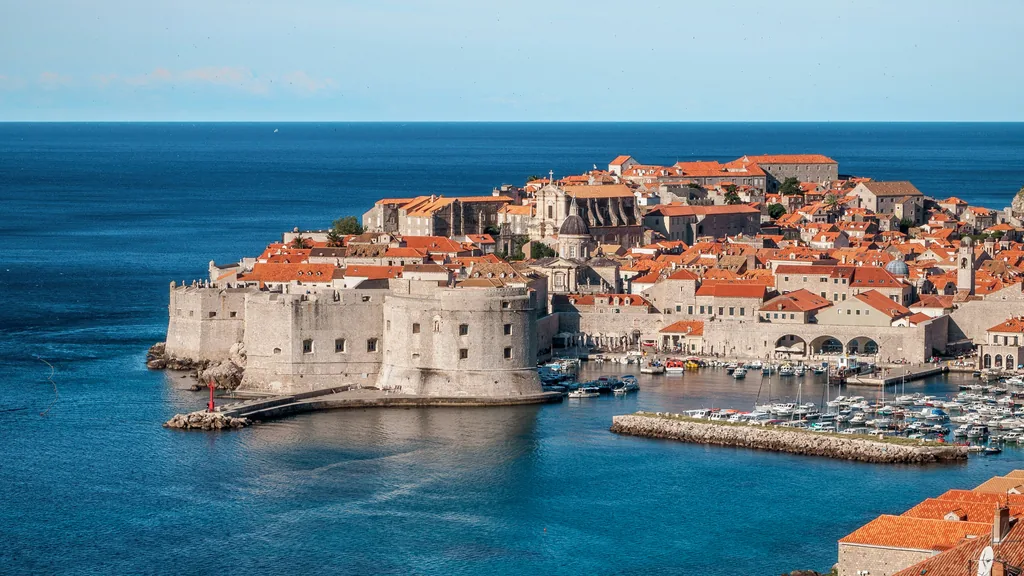
Split is not a difficult city, but it is an honest one: it was built on a hill by people who walked everywhere, over stone that seventeen centuries of feet have polished smooth, and nobody laid it out with wheels in mind. That doesn't mean you can't have a wonderful few days here with a wheelchair, a walking stick, a bad knee or a grandmother who tires after twenty minutes - thousands of people do every summer. It means the trip needs to be planned differently to the one in the brochures. This guide sets out what is genuinely flat and easy, what looks close on a map and isn't, which of the famous sights you can get into and which you can't, and how to see the viewpoints everyone photographs without climbing anything at all.
By Lovre Ostojić

The Honest Picture
Three things make Split harder than it looks in photographs. The first is the surface: the lanes of the old town are limestone worn to a shine, beautiful and genuinely slippery when wet, with worn edges, drainage channels and the occasional low step where a doorway meets the street. The second is the hill: the city climbs from the sea almost immediately, so a five-minute walk inland is a five-minute walk uphill. The third is that the things people come to see - the viewpoints, the pine woods, the best swimming - are on that hill or several kilometres along the coast.
The good news is equally real. The centre is small, so distances are short. The seafront is wide, flat, shaded and lined with benches. And because Split is a working city rather than a museum, taxis, buses and cars can get much closer to most things than visitors expect. Plan around those three facts and it works.
- Polished limestone underfoot: slippery in rain, uneven at the edges
- The city rises from the sea - inland almost always means uphill
- But the centre is small, and the seafront is flat and shaded
- Vehicles get closer to most sights than people assume
What's Genuinely Flat and Easy
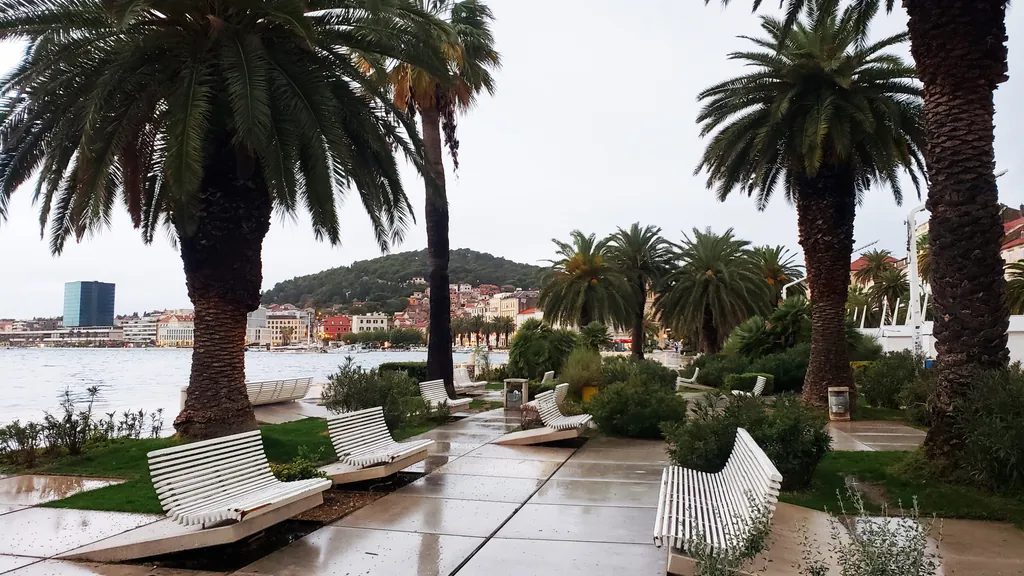
The Riva is the anchor of any trip here with limited mobility: a wide, level, paved promenade along the whole southern edge of the old town, with the palace on one side and the harbour on the other, plenty of benches, shade from the palms and awnings, and cafés with level entrances. You can spend a very happy morning without leaving it.
West of the Riva it continues past Matejuška, the old fishermen's harbour, and on along the coast towards Meje - a flat seafront path that's one of the nicest walks in the city and one of the few long ones without a climb. East, the promenade runs round to Bačvice bay. Between them you have a couple of kilometres of level, sea-facing, mostly smooth ground, which is more than most historic cities on this coast can offer.
- The Riva: wide, flat, shaded, benches, level café entrances
- West along the coast past Matejuška towards Meje - flat the whole way
- East round to Bačvice bay - also flat
- Both directions are far better surfaces than the old town lanes
Diocletian's Palace: What You Can and Can't Get Into
The palace is not one building but a quarter of the city, so the answer differs place by place. Getting into the walled area itself is straightforward from the Riva on the flat southern side. Once inside, the lanes are level in stretches and stepped in others, and the Peristyle - the colonnaded square at the heart of it, and the photograph everybody wants - sits a few steps below the surrounding lanes, which is the first place people are caught out.
The cathedral has steps at the entrance and a narrow, uneven interior. The bell tower is a steep, open staircase and is simply not possible with any mobility limitation, and there's no shame in sitting in the square while somebody else climbs it. The substructures - the vaulted Roman cellars under the southern half - are the most interesting part of the site for most visitors and the access there is mixed, with steps at some entrances and uneven floors inside. Our full palace guide describes what's in each part so you can decide what's worth the effort.
- Entering the walled area from the Riva is flat
- The Peristyle sits below the surrounding lanes - there are steps down
- The bell tower is out of the question, and that's fine
- Ask at the ticket desk about step-free routes into the cellars
Marjan Without the Climb
Marjan is the pine-covered hill above the city and the reason Split feels like it does. The famous way up is the stone staircase from Veli Varoš to the Vidilica terrace - a few hundred steps, no handrail for most of it, no shade, and out of reach for a lot of people.
What is much less well known is that a road runs up and along the hill, and everything the staircase reaches is also reachable on wheels. Vidilica, the first viewpoint, and the road along the ridge with its lookouts over the harbour and the islands can all be driven to and enjoyed from a bench a few metres from where the vehicle stops. This is the single biggest difference between a frustrating trip and a good one, and it's covered in more detail in our Marjan Hill guide and the places in Split you can't easily reach on foot.
- The Varoš staircase is hundreds of unshaded steps - skip it
- A road reaches the same viewpoints
- Vidilica has a terrace, seating and shade at the top
- Ask the driver to stop at the ridge lookouts, not just the first one
Beaches You Can Actually Reach
Bačvice is the obvious choice: a sandy city bay a short, mostly level walk from the centre, with a very gradual entry into the water - you can wade out a long way before it reaches your waist - plus cafés, showers and facilities right behind it. Sand rather than pebbles also makes it far kinder on unsteady feet than most of the Adriatic.
Žnjan, further east, has been rebuilt in recent years with wide paved promenades, parking close to the water and modern facilities, and it's the flattest big beach in the city. Kašjuni, on the Marjan side, is the prettiest swim near town, but the approach involves a slope down from the road, so it depends how you are on inclines. Our beaches guide covers the rest, including the ones we'd avoid here.
- Bačvice: sand, very shallow, close to the centre, full facilities
- Žnjan: newly rebuilt, wide flat promenades, parking near the water
- Kašjuni: lovely, but there's a slope down from the road
- Ask locally about beach wheelchairs before you rely on one being there
Getting Around: Taxis, Buses and the Port
Distances in Split are short enough that taxis are cheap by western European standards, and for anyone with limited mobility they're the default rather than a luxury: a taxi to Vidilica or along the coast costs a fraction of what the same trip would in most cities. Ride-hailing apps operate here too and are usually the easiest way to get a car to a specific spot without explaining an address in Croatian.
City buses are frequent and inexpensive, and newer vehicles on the main routes are low-floor, though not every bus on every route is. The ferry port, the bus station and the train station are all clustered together at the eastern end of the Riva, five flat minutes from the palace, which makes arriving by boat or bus considerably easier than arriving anywhere uphill. How to get around Split has the general practicalities.
- Taxis are short and cheap here - use them freely
- Ride-hailing apps work well and avoid address confusion
- Buses are frequent; low-floor vehicles are common but not universal
- Port, bus and train stations are together, and flat to the old town
Arriving by Cruise Ship
The cruise berths are a short distance east of the old town along the harbour, and the walk in is flat, though it can be long and exposed in the middle of the day - shuttle buses usually run, and they're worth taking even if you'd normally walk. Once you're at the Riva you're already at the palace.
The thing to watch on a ship day is the clock. With limited mobility everything takes longer, queues are harder, and the middle of the day is the hottest and busiest. Rather than trying to walk a full itinerary, most people do far better seeing the city seated and keeping the walking for one or two places they really want. Split shore excursions for cruise passengers and our one day in Split itinerary cover what fits into a short window.
Seeing the Viewpoints Without Walking
This is the practical answer to the question this whole article is about. Everything visitors photograph in Split that isn't inside the walls - Vidilica, the ridge lookouts, the west coast, Sustipan, the beaches on the far side of Marjan - sits on roads. If you can sit in a vehicle and get in and out of it a handful of times, you can see all of it, and you can see it in an hour and a half rather than a hard day.
That's what our tours do, and we should be straight about what they are: an open vintage tuk tuk, seats you step up into, no ramp and no wheelchair securing, so they suit somebody who can transfer with a hand and a moment rather than somebody who needs to stay in their chair. A folded wheelchair or a walker travels fine. If that fits, the Classic Tour covers the viewpoints and the coast with short, optional stops and no walking between them, and we're happy to slow the whole thing down, skip a stop or wait as long as you like. If it doesn't fit, an adapted taxi or a private car with a driver does the same job, and we'd rather tell you that than sell you the wrong thing. Get in touch before you book and tell us honestly what you can manage, and we'll tell you honestly whether we're the right option.
- Every major viewpoint in Split is reachable by road
- Our tuk tuks: a step up, no ramp, no chair securing - transfers only
- Folded wheelchairs and walkers travel with no problem
- Tell us what you need beforehand and we'll say if we're not right for it
Heat Is an Access Issue Too
July and August in Split now regularly reach the mid-thirties, and the stone holds it: the old town at three in the afternoon is a hot, bright, crowded, glaring place, and for anybody with a heart condition, a breathing problem or simply less stamina, the heat will limit the day far more than the steps will.
The answer is the local one. Be out between seven and eleven, spend the middle of the day indoors, in shade or in the sea, and come out again after five when the city becomes pleasant. May, early June, September and October are all considerably kinder and no less beautiful - best time to visit Split sets out the year month by month, and for a trip like this the shoulder seasons are worth planning around. If summer is your only option, our guide to Split in July and August sets out how to plan a day around the heat.
- Mornings before eleven, evenings after five - lose the middle
- Shade is scarcer in the old town than the photographs suggest
- May, June, September and October are far easier months
- Carry water; there are public fountains but they're spread out
Toilets, Benches and Shade
The practical things nobody writes about. Public toilets exist around the centre and the main beaches, and there are accessible ones, but they are not on every corner and they are not always open out of season - the reliable strategy in a café city is to buy a coffee and use theirs. Many older buildings have their facilities up or down a flight of stairs, so it's worth asking before you sit down rather than after.
Benches are plentiful along the Riva and the coastal promenades and scarce inside the old town, where you're generally sitting in a café or on a step. Shade is the same story: generous on the seafront, patchy in the lanes, absent on Marjan's staircase. Plan the day around where you can sit down.
- Buy a coffee and use the café's facilities - simplest approach
- Ask about stairs to the toilet before you sit down
- Benches: many on the Riva, few inside the walls
- Accessible toilets exist but aren't everywhere - don't rely on finding one
Where to Stay If Stairs Are a Problem
This matters more here than in most cities. Split is an apartment city rather than a hotel city, and a great many of those apartments are on the second or third floor of an old building with no lift and a narrow stone staircase. Inside the palace walls, cars cannot reach the door at all, so luggage - and you - arrive on foot over cobbles.
So: ask the host directly whether there is a lift, how many steps there are from the street, and how close a car can park. Get an answer in writing. Bačvice, Žnjan, Meje and the newer parts of the city have flatter streets, lifts and parking, and are the sensible choice over the romance of sleeping inside a Roman palace. Where to stay in Split compares the neighbourhoods in detail.
- Ask: is there a lift, how many steps from the street, where can a car stop
- No vehicle access at all inside the palace walls
- Bačvice, Žnjan and Meje are flatter, with lifts and parking
- Get the answer in writing before you pay
Pacing a Day That Works
The shape that works is one thing in the morning, a long lunch, and one thing in the late afternoon. Not three sights, not a checklist. A morning inside the walls at the level parts and a coffee on the Peristyle steps is a full morning. An afternoon seeing the viewpoints and the coast from a vehicle is a full afternoon. That's a very good day in Split, and people who try to do more of it end up doing less.
Build in the fact that everything takes longer: crossing the old town, finding a level entrance, waiting for a taxi in August. And leave the evening alone. The Riva after eight, flat and lit and full of people, is the best part of the city and it asks nothing of you.
What We'd Skip
The bell tower, always. The Marjan staircase, always - take the road. Full-day island trips, which mean gangways, tenders, crowds and no control over the pace; if the sea is the point, a shorter private boat with a skipper who can help you aboard is a far better trade. The Blue Cave in particular means climbing into a small boat in open water, and we'd talk almost anybody with mobility limits out of it.
Krka is possible - the boardwalks are long but level in stretches - though it's an hour and a half each way and a lot of walking once you're there. Klis Fortress, for all its view, is rough, unfenced and steep. Our day trips guide is honest about the effort each one involves; on this kind of trip, Trogir is the pick, because it's flat, small and everything is close together.
- Skip: the bell tower, the Marjan steps, the Blue Cave
- Careful: Klis is rough and unfenced; Krka is level but long
- Best day trip: Trogir - flat, compact, everything close
- A private boat beats a full-day group excursion
The Short Answer
Split works with limited mobility if you accept two things: you will see the old town in pieces rather than as a loop, and you will reach the viewpoints on wheels rather than on foot. Do that and you get the palace, the market, the seafront, the sunset, the swimming and the panorama over the islands - which is, honestly, all of it.
What doesn't work is arriving with a walking itinerary and hoping. Ask the questions early: about the apartment stairs, about the vehicle, about how far it is from where a car can stop to where you want to sit. Everybody here is used to being asked, and the ones worth dealing with will give you a straight answer. If you'd like ours, tell us what you need and we'll tell you what we can and can't do.