Split on a Rainy Day: What to Do When the Weather Turns
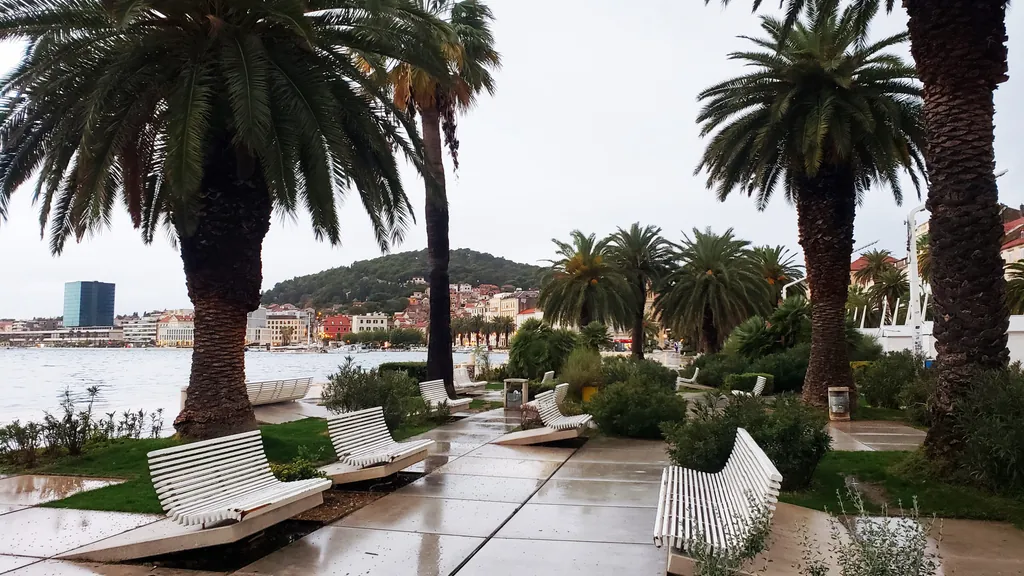
It does rain in Split. Not often, and rarely for long, but when it comes it comes properly. The marble in the old town turns to glass, the Riva empties, and the boat trip you booked for today gets a polite message cancelling it. The good news is that Split is one of the better cities on the Adriatic to be rained on. Half of Diocletian's Palace is under a roof. The museums are small, good and close together. And the whole city runs on long coffees and longer lunches, which is exactly what a wet day is for. This is how we spend a rainy day here, what the two local winds mean for your plans, and why you should keep an eye on the sky, because the hour after the rain is often the most beautiful hour of the week.
By Ante Elez
The Short Answer
Spend the wet morning inside the palace. The great halls underneath it are dry, cool and one of the most impressive Roman interiors anywhere. The cathedral, its crypt and its treasury are a few steps away.
If it is still raining after that, pick one museum. The Meštrović Gallery is the best in the city and worth a taxi. Then have a long lunch in a konoba, and a coffee afterwards that takes as long as the rain does.
Keep your boat trip for a dry day, and move the island day if the forecast shows strong wind. Most rain here comes in bursts rather than all day, so check the hourly forecast rather than the daily one, and be ready to go out as soon as it clears.
- The palace halls, the cathedral and the crypt for the wet morning
- One good museum, the Meštrović Gallery if you only pick one
- A long lunch in a konoba, then a longer coffee
- Save the viewpoints for the hour after the rain
When It Rains in Split
Split is one of the sunniest cities in Europe, with well over two and a half thousand hours of sunshine a year, and most visitors never see a wet day at all. The rain it does get falls mostly in autumn and winter. October, November and December are the wettest months, and November usually tops the list.
Summer is different. July and August are very dry. When it does rain, it usually comes as a short thunderstorm in the late afternoon, heavy for an hour and then gone, and the stone streets steam dry before the evening. Spring sits in between, with showery days in April and a much drier May.
The practical point is that a day of rain in the forecast is rarely a day of rain on the ground. Look at the forecast hour by hour. In autumn, a wet morning very often turns into a clear, bright afternoon.
- Autumn and early winter are the rainy season, November most of all
- Summer rain is usually a short afternoon storm
- Read the forecast by the hour, not by the day
- A wet morning often means a clear afternoon
Jugo and Bura, the Two Winds That Decide Your Day
Ask anybody in Split about the weather and they will tell you about the wind before the rain. Two winds decide most of the bad weather here, and they could not be more different.
The jugo blows from the south east, off the sea. It is warm and damp, it brings grey skies and most of the rain, and it pushes big waves onto the waterfront. Locals blame it for headaches, bad moods and short tempers, only half joking. On a jugo day the islands disappear into haze and the sea is rough, and that is when the small boat trips get cancelled.
The bura blows from the north east, down off the mountains behind the city. It is cold, dry and gusty, sometimes very gusty, and it usually clears the sky completely. A bura day can be the most beautiful day of your trip, with every island sharp on the horizon. It can also stop the catamarans and make an umbrella useless. After a spell of jugo rain, it is often the bura that clears it away.
- Jugo: warm, damp, grey, rain and rough sea from the south east
- Bura: cold, dry, gusty and very clear, from the north east
- Either can cancel catamarans and small boat trips
- A bura after rain gives the clearest views of the year
Half of Diocletian's Palace Has a Roof
The best rainy day sight in Split is also its most famous one. Underneath the southern half of the palace are the substructures, huge vaulted halls built to level the ground for the emperor's rooms above. They survived because the medieval town used them as cellars and rubbish tips, which is why their layout still shows you exactly what the floors above looked like. They are dry and cool, and they are spectacular in any weather.
The central corridor, from the Bronze Gate on the waterfront up to the Peristyle, is free and lined with craft stalls. The eastern and western halls are ticketed and much quieter. On a wet day they are the best value in the city.
From the top of the corridor it is a few steps to the cathedral, built inside Diocletian's own mausoleum, and to its crypt and treasury. The small Temple of Jupiter, across the lane, still has its original stone vaulted ceiling. One warning: the Vestibule, the round domed hall off the Peristyle, has lost its dome and is open to the sky, so it is no shelter at all. Our complete guide to Diocletian's Palace explains what is free, what is ticketed and what you are looking at.
- Enter through the Bronze Gate on the waterfront and you stay dry
- The central corridor is free, the eastern and western halls are ticketed
- The cathedral, crypt, treasury and Temple of Jupiter are all a few steps away
- The Vestibule is open to the sky, so do not shelter there
The Museums Worth a Wet Hour
Split's museums are small, which is exactly right for a rainy day. You can do one properly in an hour and still have time for lunch.
The Meštrović Gallery is the one we would send you to first. Ivan Meštrović was Croatia's greatest sculptor, and the gallery is the villa he built for himself in the 1930s on the southern side of Marjan, with his work in the rooms and the sea behind the windows. It is too far to walk comfortably in the rain, so take a taxi or the local bus. The same ticket usually covers the Kaštilac nearby, a small chapel with a cycle of his carved wooden reliefs of the life of Christ that many visitors never find.
The Archaeological Museum, north of the centre, is the oldest museum in Croatia and holds much of what was found at Salona, the Roman city Split grew out of. Its covered colonnade around the garden is full of carved stone and makes a good place to wait out a shower. Inside the palace walls, the Split City Museum sits in a beautiful Gothic mansion, and the Ethnographic Museum is just off the Peristyle. The Gallery of Fine Arts is by the Golden Gate.
And then there is Froggyland, a room of more than five hundred stuffed frogs posed in scenes of everyday life, made by one man over a century ago. It sounds like a joke and it is one, a little, but it is also genuinely charming and takes half an hour. Children love it.
- The Meštrović Gallery is the best in Split, take a taxi in the rain
- The Archaeological Museum is the oldest in Croatia
- The City Museum and the Ethnographic Museum are inside the palace
- Froggyland is strange, short and very good with children
- Opening hours shrink out of season, so check before you go
A Long Lunch and a Longer Coffee
Nobody in Split thinks a rainy day is a wasted day, because a rainy day is when you finally have time to eat properly. A konoba is a traditional Dalmatian tavern, and the good ones are two or three streets back from the water in Veli Varoš and around the palace. A konoba lunch that runs well into the afternoon is the local answer to bad weather.
If rain is in tomorrow's forecast, this is the day to order peka. It is meat or octopus slow cooked under an iron bell in the embers, and it has to be ordered a day ahead. A grey afternoon is when it tastes best. Our Split food guide has more on peka, pašticada and where to find a proper marenda, the cheap local lunch.
Afterwards, do what everybody else does and sit over one coffee for an hour. Coffee in Split is not a drink, it is an activity. The cafés along the Riva and in the squares have awnings and covered terraces, and on a rainy afternoon they are full of locals doing precisely nothing, very happily.
- A long konoba lunch is the local answer to rain
- Order peka a day ahead if the forecast is bad
- Covered café terraces fill up with locals on wet days
- One coffee, one hour: that is the correct speed
Markets and Shops Under a Roof
Peškarija, the fish market just west of the palace, is under its own roof and is lively in any weather, as long as you go in the morning. Pazar, the green market outside the eastern wall, is mostly open to the sky, but the stallholders put up their awnings and trade anyway, and a wet morning is a quiet time to wander it.
For shops, Marmontova, the wide pedestrian street running up from the western end of the Riva, has most of the familiar chains, and the lanes inside the palace are full of small shops selling jewellery, lavender, olive oil and wine. If the rain has really set in, the big shopping centres on the edge of the city have cinemas. Films in Croatia are shown in their original language with subtitles, so an English language film is an English language film.
- Peškarija is covered, go before lunch
- Pazar trades under awnings, quiet on a wet morning
- Marmontova and the palace lanes for shops
- Cinemas show films in the original language with subtitles
Rain With Children
Children cope with rain better than their parents do, as long as there is something to do. The halls under the palace feel like a castle dungeon and are a hit with most ages, and Froggyland is short enough for small attention spans. The cinemas and indoor play centres in the shopping centres earn their place on a proper washout.
Pack a spare pair of shoes, because the polished marble in the old town is slippery when wet and children will run on it anyway. Our family guide to Split has more ideas for rainy days and for days that are simply too hot.
- The palace halls feel like a dungeon, which is the point
- Froggyland is half an hour and funny
- Cinemas and indoor play centres for a proper washout
- Spare shoes, because wet marble is slippery
Boats, Islands and the Weather
The sea decides more of your plans than the rain does. Small boat trips, and above all the Blue Cave on Biševo, are the first things cancelled when the sea gets up, because the cave can only be entered in calm water. Strong jugo or bura can also cancel or delay the fast catamarans. The big car ferries are much more robust and usually keep running.
So if your trip has an island day in it, do not fix it to a date and hope. Look at the week's forecast when you arrive, put the island on the calmest, driest day, and keep the city for the wet one. Check with the operator the evening before. Most will contact you if a trip is cancelled, but it is better to ask than to stand on the pier.
One day trip works well in the rain: Krka National Park. The walk around the waterfalls is on boardwalks through the woods, and after heavy rain the falls are at their most powerful. Our day trips guide explains how to get there.
- Small boats and the Blue Cave are cancelled first when the sea is rough
- Strong wind can stop catamarans, car ferries usually still sail
- Put your island day on the calmest day of the week
- Krka is at its most powerful after rain
Walking in the Rain Without Falling Over
The one real danger of a wet day in Split is the ground. The streets of the old town are limestone polished smooth by seventeen centuries of feet, and when they are wet they are genuinely slippery. Locals slow down, and so should you. Shoes with a proper grip matter more than a good umbrella.
Talking of umbrellas: in a bura they turn inside out in seconds, and in the narrow lanes of the palace they catch on everybody else's. A light rain jacket with a hood is the better choice. The steps up Marjan are best left for another day, both because they are slippery and because the view from the top will be cloud.
- Wet marble is slippery, slow down
- Shoes with grip matter more than an umbrella
- A hooded jacket beats an umbrella in wind and narrow lanes
- Leave the Marjan steps for a dry day
The Hour After the Rain
This is the part of a rainy day in Split that nobody writes about. Rain here rarely lasts all day, and when it clears, especially when the bura comes in behind it, the air is washed clean. The islands of Brač, Šolta and Hvar, which are a haze on a summer afternoon, stand out sharp enough to count the houses. The stone of the old town glows. The viewpoints are empty, because everybody else has already given up on the day.
So keep an eye on the sky. The moment it breaks, head for the views: the Vidilica terrace above the old town, the lookouts on the western side of Marjan, or Sustipan on its headland. Our guide to the best viewpoints in Split has all of them. A clearing afternoon in October is the best light for photographs that Split has all year.
- Rain rarely lasts all day here, so watch the sky
- After rain, especially with a bura, the views are at their clearest
- The viewpoints are empty because everybody else has given up
- October clearing light is the best of the year for photos
Where We Fit, and Where We Do Not
We run tuk tuk tours, so read this section knowing that. And the honest answer is that a tuk tuk is not a rainy day activity. Our tuk tuks have a roof, which is shade in summer, but they are open vehicles, and in real rain the views that are the whole point of the ride are behind the cloud. We said it in our guide to the best tours in Split and we will say it again here: if it is pouring, a tuk tuk is not what you want.
Where we fit is the hour after the rain. The viewpoints and coves of the Marjan peninsula are too far to walk to in the time a clearing sky gives you, and the steps are still wet. A ride out there, stopping at Vidilica and the western lookouts in that washed, clear light, is one of the best things you can do in Split all year. Every tour includes an ice cold drink, even in October. Our Classic Tour is eighty minutes, which is about the length of a good clear spell.
If you have a booking and the forecast looks bad, message us on the day. We will tell you honestly what the sky is doing.
- A tuk tuk is an open vehicle, not a way to stay dry
- In a downpour, do the palace, a museum and lunch instead
- The clear hour after the rain is the best time to ride out to the views
- Booked and worried about the forecast? Message us on the day
What We Would Tell a Friend
Do not waste a rainy day in your apartment. Go into the palace through the Bronze Gate and stay underground for an hour. Take a taxi to the Meštrović Gallery. Eat a long lunch somewhere with a roof and no hurry. Put the island day on the calmest day of the week, not the first one.
And keep watching the sky, because in Split the rain nearly always stops. When it does, get up high as fast as you can. The view after the rain is the one you will still be showing people at home.